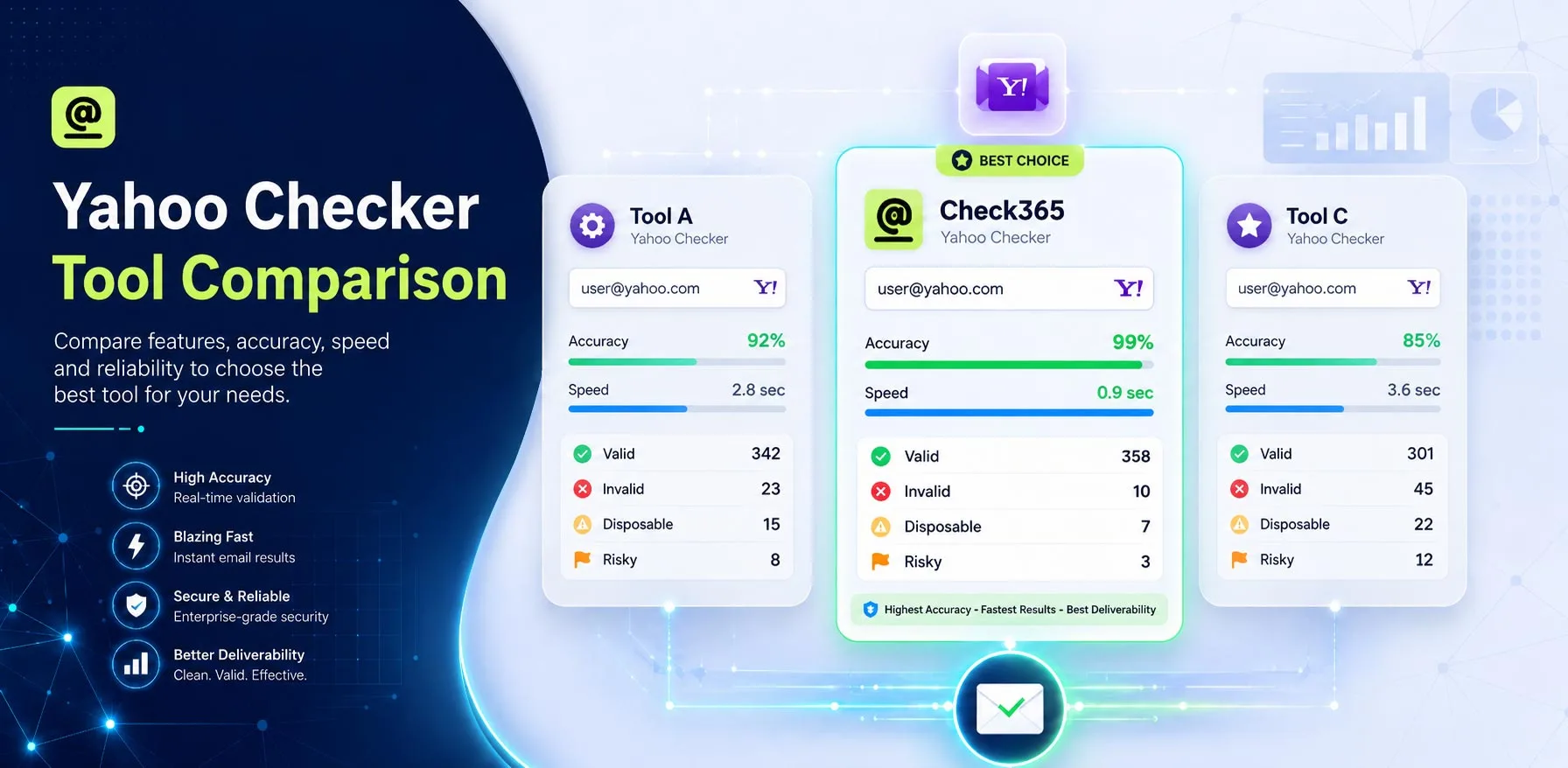
A large email list doesn’t mean you have a healthy email list. Addresses may become inactive, may be inaccurate, may employ temporary inboxes or may change in the degree of risk of delivery over time. This is why it’s crucial to validate your email addresses before sending out a huge campaign. In this test we examined what occurs when 10,000 email addresses are validated and what information a validation tool can provide beyond a simple valid/invalid response. We used Check365 to look at mailbox status, email type, provider, role, risk, MX records and deliverability judgments.
What Does Check365 Show When You Validate an Email Address?
You can get more than just a "valid or invalid" answer from Check365 when you check an email address. The email status, email type, email provider, email role, deliverability decision, risk level, MX record, and reason can all be in the findings. Like, an active address might show Google Workspace as the provider, Non-Role as the email type, Low risk, and Safe to Send as the deliverability decision. The reason might say "Mailbox Verified," which gives you more information about the finding.
How We Validated the 10,000 Email Addresses?
We first made a list of 10,000 email addresses to make sure they were real before testing a big email database. Before handling the list, it should be checked for mistakes in formatting, duplicates, and empty spaces. After that, we quickly checked the addresses using Check365's bulk validation method. The validation process didn't just check to see if each email had the right format; it also gave information about the mailbox's status, provider, risk, role, and deliverability. Once the validation was done, the findings could be looked over and put into groups based on their different categories.
Key Findings: What 10,000 Email Validations Taught Us
- The quality of your email list is important. Even if the addresses look like they are formatted properly, a large database may contain invalid or troublesome addresses.
- Not every email can be delivered. Validation helps separate addresses that can be used from emails that are invalid, risky, disposable, or unclear.
- Checking the state of your mailbox can help you: The cues from results like "Active" and "Mailbox Verified" are stronger than those from simple syntax checking.
- Levels of risk help people make decisions: It's easier to decide which contacts to keep on your list once you know which addresses are low-risk and which ones could be risky.
- Email service providers can show you useful patterns: A business can better understand its information if it knows if addresses use Google Workspace, Gmail, or other services.
- Decisions about deliverability are useful because: Results like "Safe to Send" make it easy to tell if an address looks like it would work for email campaigns.
- Validation does not guaranty placement in the inbox: Even if an email is valid, it might still end up in spam or have other delivery issues, so validation should only be one part of a larger plan to make sure emails get delivered.
- It's important to clean up lists often: Over time, email addresses can stop working. Validating them on a regular basis is a good way to keep your database cleaner and more reliable.
What Can a 10,000 Email Test Reveal?
By testing 10,000 email addresses, you can find out how good and deliverable an email database is as a whole. Validation can put addresses into different groups based on their verification results, so it's not necessary to assume that every address can be used. You might find live mailboxes next to addresses that aren't valid, are risky, are disposable, or aren't clear. Patterns can also be found across email providers, types of emails, and mailbox statuses. Before starting campaigns, these results help companies figure out how much of their information can actually be used. A large-scale test also shows how important it is to clean up email lists on a regular basis.
What Happens When You Validate Microsoft 365 Emails?
When you confirm Microsoft 365 email addresses, the process checks the signals that are out there to see if each address looks like it could be delivered. Many business addresses use Microsoft 365, so this is especially helpful for companies that manage lists of business-to-business. The data can tell you about the email's status, its provider, its job, its risk level, its deliverability decision, and the reason for verification. You might see results that say an email is active, safe to send, or linked to a certain level of risk, depending on the address.
Check365 Features We Found Useful
Check365 has some useful capabilities for businesses that want to verify single emails or clean huge email databases. In the validation process we found the following aspects to be really useful:
- Single Validation: Validate single email address with thorough validation info.
- Bulk Validation: It allows you to validate large lists of email addresses at once and is more convenient to use for large databases.
- Validation Detailed Results: Check facts like email status, email type, provider, role, risk level, MX record, deliverability decision and validation reason.
- Validation History: View the dashboard for historical email address validations and their outcomes.
- Credit Tracking: Check your remaining validation credits immediately from the dashboard.
- Validation Activity: Monitor your email-checking activity to see how your available credits are being spent.
- API Validation: Integrate email validation into your company processes with API choices. Automate individual or batch inspections.
Frequently Asked Questions
Does Email Validation Reduce Bounce Rates?
Bounce rates can be lowered by finding invalid, inactive, or risky email addresses before promotions. Getting rid of bad emails keeps your list cleaner, protects the sender's reputation, and makes campaign delivery much better overall.
What Does “Safe To Send” Mean In Check365?
"Safe To Send" means that Check365 has checked the address and found it to be valid before sending. It shows that the message is likely to be delivered, but it doesn't guaranty that it will land in the inbox or be engaged with.
What Does “Mailbox Verified” Mean?
If it says "Mailbox Verified," it means that Check365 was able to validate the mailbox. Based on the known verification signals, this result shows that the address seems to exist and can receive email.
What Does The “Risk” Level Mean?
The "Risk" level shows how likely it is that an email address will not be delivered. Check365 can give each address a risk level, which can help you decide whether to keep, review, or delete names before sending campaigns.
Can Check365 Identify The Email Provider?
Yes, Check365 can find out which email service is linked to a certain address. Its validation results might show companies like Google Workspace, which helps users figure out which email service handles the mailbox that the address points to.
Does Email Validation Guarantee Inbox Delivery?
Email validation alone can't guaranty arrival to the inbox. There are many things that affect where and how emails get delivered, including the sender's reputation, authentication, content, engagement, and the policies of the receiving provider. Even if the address is valid, it may still end up in spam or be filtered.
Conclusion
By checking 10,000 email addresses, we can see that the quality of our email lists needs to be looked at before we start big campaigns. Just because an email address looks simple doesn't mean that the mailbox is current, deliverable, or ready to be sent to. Check365 gives you more details, like the status of your mailbox, your email provider, your email role, the amount of risk, your MX records, and deliverability choices. This can make managing your lists easier.