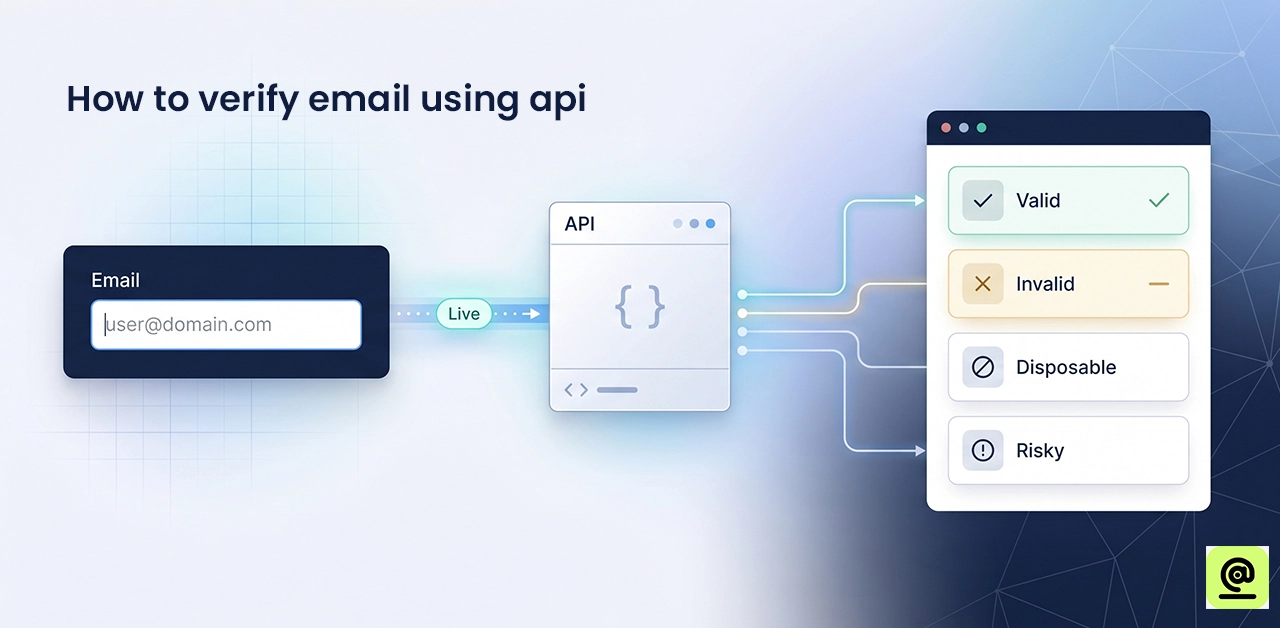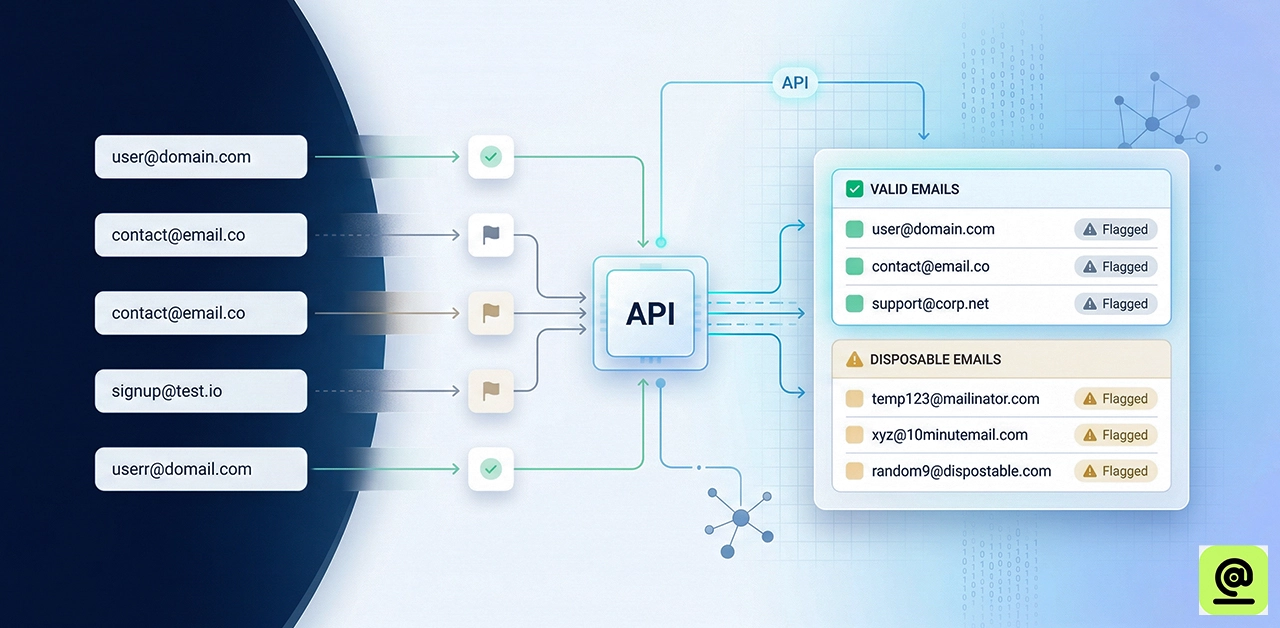
In 2026, the signup form is where you start to defend your digital marketing ROI. Businesses are getting more throwaway email addresses than ever before because of the fast increase of automated botnets and "serial trial" abusers. These temporary mailboxes, which are meant to disappear in a few minutes, do more than simply make your CRM messy; they also hurt your sender reputation and get you in trouble with big ISPs like Gmail and Yahoo. It's not enough to just use old ways of checking. Every day, thousands of new burner domains are registered, yet static blacklists and simple Regex criteria can't keep up.
7 Ways To Detect Disposable Emails Using an Email Checker API Tool
To find disposable emails with the Check365 Email Verification API, just follow these simple steps:
- API Integration: Use a simple GET or POST request with your API key to link your signup form to the Check365 endpoint.
- Real-Time Trigger: Set the validation to start as soon as the user finishes typing their email address so that "burner" addresses are caught right away.
- Live Database Check: Check365 checks the domain against its own list of temporary email providers, which is updated often.
- MX Record Verification: The API checks to see if the domain has a working Mail Exchange (MX) setup, which keeps out bogus or dead domains.
- SMTP Handshake: Check365 "pings" the mail server to make sure the mailbox is there without sending a message.
- Heuristic Analysis: The system uses metadata to find patterns that are common to 10-minute mail services, even if the domain is fresh new.
- JSON Response: The API sends back a direct answer, like "disposable: true." If flagged, your system can immediately ask the user for a "work" or "permanent" email.
What Are Disposable Emails And Why Do They Matter?
Disposable emails, also known as burner or 10-minute mails, are temporary addresses that are meant to stop working soon after they are used. They let people get a single confirmation number or download link without having to give their real name or other personal information. People usually leave these mailboxes empty within minutes or hours, so a firm can't get in touch with the user again.
Why They Are Important
These addresses could seriously hurt your sender reputation and return on investment (ROI) for marketing. In 2026, big email services like Gmail and Yahoo will have stringent bounce rate limits. If you send emails to expired disposable accounts, your domain could be blacklisted. Also, they let "serial trial abuse" happen and mess up your analytics by putting "dead" leads in your CRM that will never turn into real customers.
Why Manual Filtering And Regex Fail In 2026?
- Syntax vs. the real world: Regex merely checks to see if an email address appears right, like if it has a @ and a .com. It can't check to see if the mailbox really exists. Sending to fake addresses in 2026 will get you in trouble with your ISP right away and cause high bounce rates that hurt your sender reputation.
- How fast "burner" domains are: Blacklists that are made by hand are always the same, whereas throwaway email providers are always changing. They currently employ automation to register thousands of new names per day in cheap TLDs. Real-time rotation is too fast for manual upgrades to keep up with modern botnets and trial-abusers.
- The Privacy Relay Fight: Generic filters often block real "Hide My Email" addresses from Apple or Firefox by mistake. This causes Revenue Leakage since it turns away legitimate customers who care about privacy. Modern APIs can tell the difference between a bad burner and a real privacy relay.
- No communication between servers: Regex is "blind," which means it can't do an SMTP Handshake. You can't find "Catch-all" domains or Spam Traps without talking to the mail server. You can only "ping" the server with an API to make sure it is ready to receive mail before you send it.
Frequently Asked Questions
Is It Better To Block Unwanted Emails Or Just Delete Them?
In 2026, you should report and filter spam emails instead of just deleting them. When you delete an email, nothing happens to your filter. When you mark a message as "Junk" or "Spam," it teaches your email provider's AI to look for similar patterns, headers, and bad domains. This not only keeps your inbox safe in the future, but it also helps spam filters throughout the world find the sender and block them for other users.
How Often Are Disposable Domain Lists Updated?
High-quality disposable domain lists are updated every day or in real time. Static listings that are updated once a week or once a month are only roughly 43% to 64% accurate because "burner" suppliers can produce hundreds of new domains for a few bucks. In 2026, you will need to utilise an API-based validator that employs machine learning to find new domains based on their nameserver patterns and WHOIS age, instead of a static text file. This will keep you safe 99% of the time.
How Do APIs Detect "Catch-All" Domains?
APIs find "catch-all" (or Accept-All) domains by doing a fake SMTP handshake. The API sends a message to the mail server requesting if a random, made-up address (like xyz_999@domain.com) exists. The API marks the whole domain as a catch-all if the server sends back a "Success" code instead of a "550 User Not Found" error. Modern APIs from 2026 also look at old bounce data and domain settings to give you a "deliverability score" for these problematic addresses.
How Often Do "Burner" Databases Need To Be Updated?
You have to update burner databases all the time, at least once every 24 hours. The life cycle of a disposable email domain is quite short; many are registered, used for spam or trial abuse, and then left alone within 48 to 72 hours. If your validation tool hasn't synchronised its database in more than a week, it probably won't find more than half of the active temporary mail services that bots and "serial-trial" users are using right now.
Final Verdict
You can do live SMTP handshakes and heuristic analysis with an automated solution. This lets you prevent bad throwaway addresses while still letting real users who employ privacy relays access. In the end, the only way to protect your deliverability and get the most out of your marketing budget in a "zero-trust" digital world is to stop using human filters.
.webp)